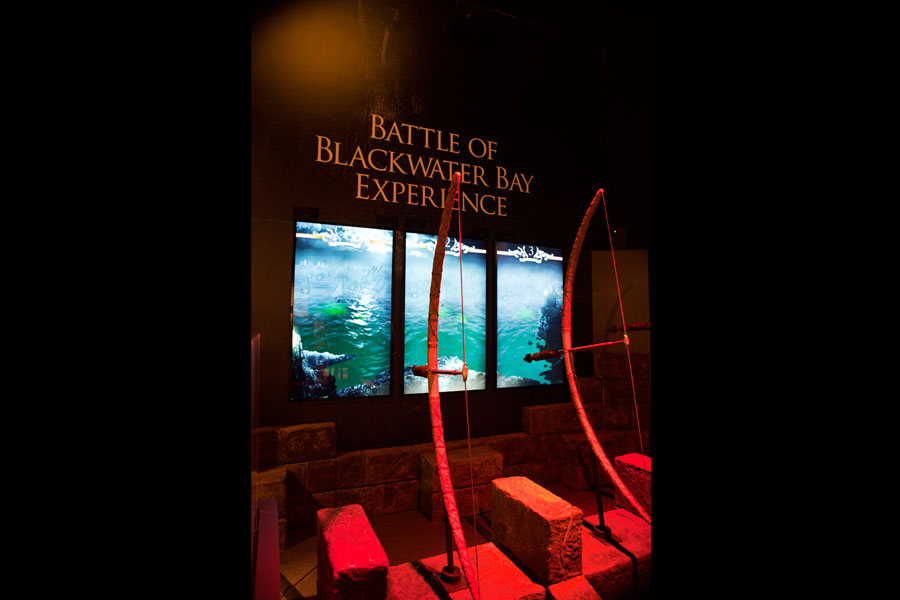

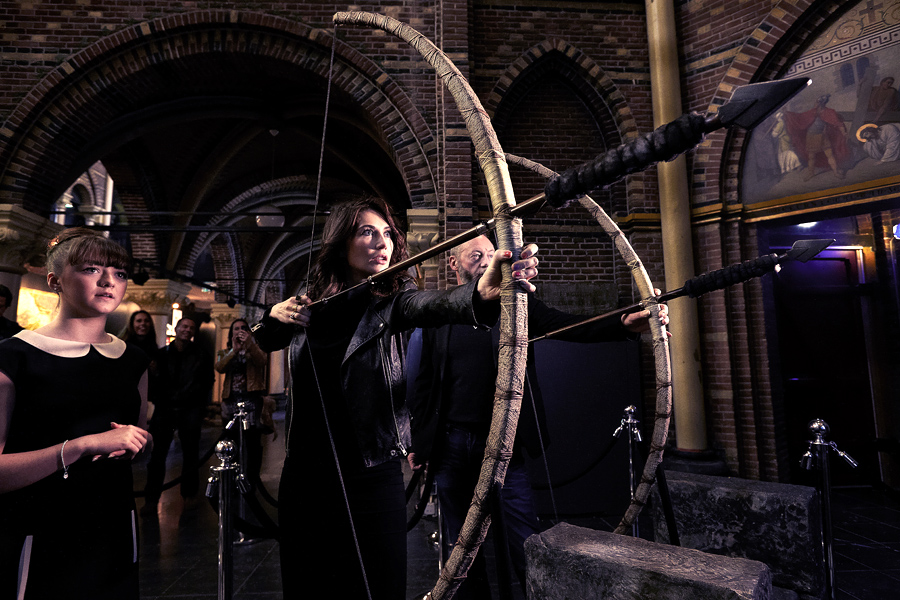

Unity 3D Game Engine. Code written in UnityScript and some C#. Hardware: Custom fabricated long bows that could be panned left and right and tilted up and down. The bow motion was tracked with a 9 Degrees of Freedom Sensor- a chip that measures position, rotation and heading in 3D space. Open Sound Control (OSC) Protocol used to transmit the serial data from the sensor into Unity via USB.
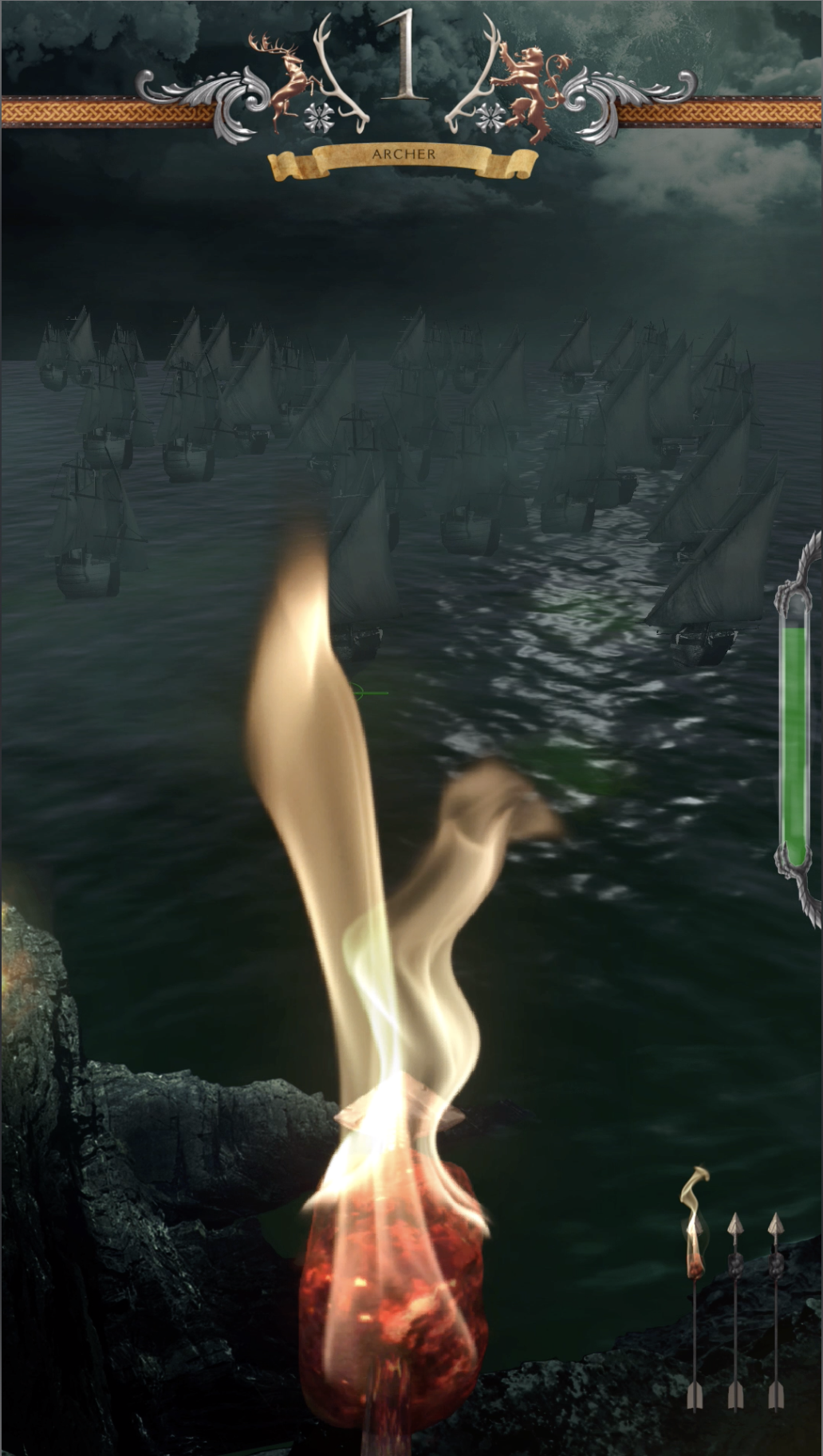
We were tasked with building the first and only interactive experience in an exhibit of mostly costumes, props and videos. We wanted the game to be very short and engaging enough that players were interested in playing through to the end, either destroying all enemy ships, or using up all 5 arrows trying.
We knew this project would require a 3D perspective to convey shooting arrows from the player off into the distance. So I chose to built it in the Unity 3D Game engine. However, time constraints prohibited the design and implementation of a full 3D game experience. So we worked through several design iterations before landing on a realistic looking scenario with mixed 2D & 3D assets and some short video clips for the explosions.
To detect the panning and tilting motion of each of the fabricated long bows, we used the accelerometer data from 9DOF Sensor Stick - a tiny device that measures position, rotation and heading in 3D space. The pull and release of the arrow was detected by a light sensor that was mapped to a keyboard input.
An unexpected challenge of using 2D assets in a 3D environment was mapping users' aim of the physical bow and arrow to the on-screen targets in a manner that was responsive and intuitive. During early iterations, users were not getting an accurate sense of where the physical arrow was aiming on-screen, so the shooting was random and frustrating. I resolved this by adding a crosshair image that mapped to the sensor data and provided a visual indicator of where they could expect their arrow to land.
This was the first time I had worked with the 9DOF sensors. One surprising discovery was that the presence of metal near the long bows could affect the sensor readings. Thus valid sensor values would vary between bows and from venue to venue. To handle this, I developed a procedure that allowed each bow to be calibrated to perform optimally in existing conditions without requiring any software changes or config file edits. This procedure was straightforward and clearly documented so it could be performed on-site by non-technical exhibit attendants.